

The International Video Game Hall of Fame proudly announces Class of 2025 Inductees. In going through the rigorous process of screening, vetting and voting by our committees of industry experts, we’re very happy to share the valued people, organizations and products that helped to shape and guide the growth and direction of all forms of interactive entertainment, including the competitive side of gaming.
As with all historical reflections, there are fantastic stories associated with each Inductee, and why they deserve to rise up and be recognized for their contributions to the ongoing evolution of digital media and the enjoyment we get from taking part.
This class joins our other illustrious other Inductees from previous years, to take part in the acknowledgement and historical significance of each with their overall contributions. We are proud to be able to highlight and recognize this class, and hope the wider community can spend a few moments and appreciate how each have driven key components of our game playing, design, business acumen and overall entertainment. A small journey through memory lane is always a fun endeavor, especially when understanding unique innovation and competitive achievement are part of that journey.
Enjoy the list, reflect on the contributions and above all, enjoy the fun each Inductee contributed in some way, shape or form to whatever game you are playing today!
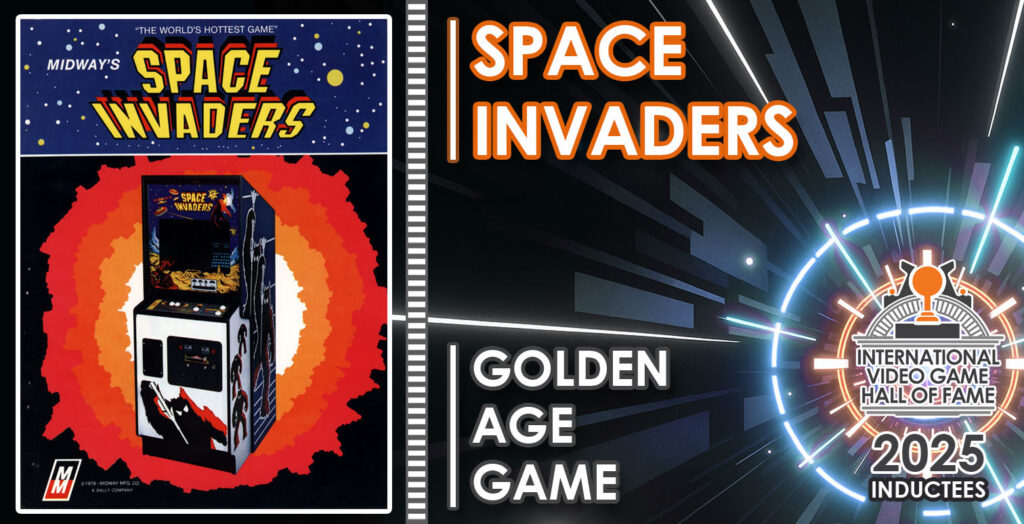
One of the cornerstones in innovative game design, Space Invaders took the game industry to a whole new level, including one of the highest production runs of all arcade machines ever. It’s simple and uniquely addictive gameplay set the foundation for all future video game development and helped to accelerate the growing culture centered around arcade gaming within our society.
Space Invaders was the brainchild of Tomohiro Nishikado, drawing inspiration from science fiction narratives like War of the Worlds and Star Wars. He also wanted to generate the same feeling of tension and achievement found in Atari’s Breakout ̶ where the blocks at the top of the screen eventually turned into menacing invaders ̶ which was also quite popular in Japan at the time.
Developed and produced by Taito for the arcades, it was released in Japan in April 1978 and then licensed to Midway Manufacturing in the US later that year. Nishikado-san spent over a year in development on it, including trying to get the pixel-based art just right and having to develop new hardware to perfectly execute the game vision as well.
It was one of the first arcade games that could be played forever due to the removal of the standard ‘timer’ with added tension as the invaders moved faster and reaching the bottom would trigger “GAME OVER” instead. It also established both the style and genre for the classic alien shoot-em-up and quickly became a cultural phenomenon. Space Invaders was literally everywhere: in grocery stores, movie theaters, and more. The effects of how it changed conversations about video games in general were plastered all over TV, magazines, and newspapers around the world.
It was the highest-selling and highest revenue-generating form of entertainment at the time with estimated gross sales of approximately $14 billion, and over 750,000 units built and shipped worldwide. Once you add in the copy-cats and new games inspired by Space Invaders, it was plain to see a movement that took the world by storm. The title became the first ‘killer app’ for all home platforms as well, spawning countless home conversions, iterations, similar products and outright knock-offs. The gaming world was forever changed.
With this monumental development unleashed in the world, the expectations for the video game industry as a whole only increased with what was possible. In the decades since, numerous magazines and websites have acknowledged the historical significance of Space Invaders with inclusion in their “Top 100 Video Games” or “Best Games of All Time” lists, including entries in the Guinness Book of World Records. The International Video Game Hall of Fame is honored to add our stamp of approval to the game’s accolades by inducting Space Invaders as a member of the Class of 2025.
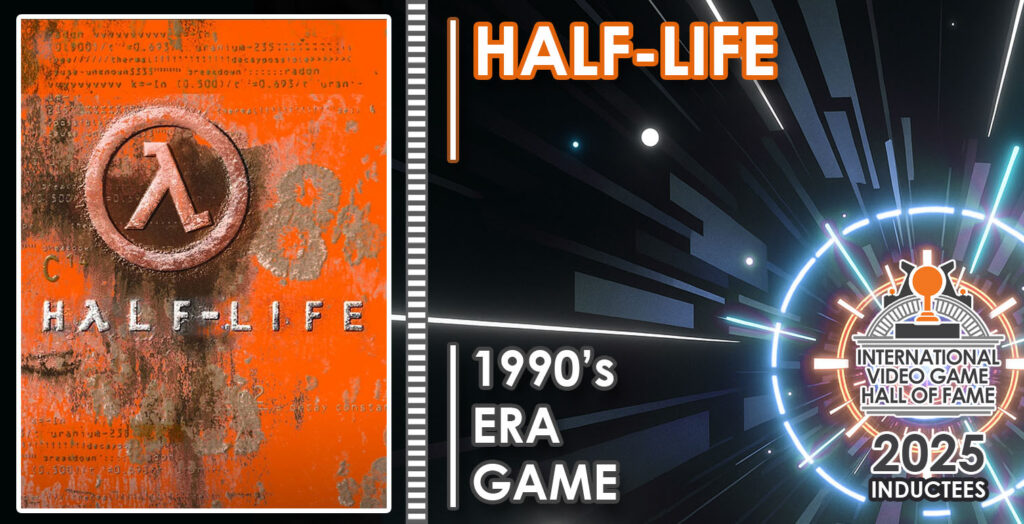
Half Life is the “thinking-man’s” game of its generation, proving for the first time ever that the first-person-shooter (FPS) genre can be far more than just mindless mayhem and destruction.
Prior to the game’s creation, all other FPSs were high-adrenaline action, non-stop blasting with minimal plot and story development. With their first original game under the Valve moniker, the brilliant post-Microsoft team (featuring Gabe Newell) went on a completely different journey to show there is something far greater in this relatively new genre and believed something more was possible. Valve was on a quest to prove that a focus on story and logical puzzle-solving also could define this emerging genre where others were focused on an endless shooting as the core experience.
Released in November 1998 to universal acclaim, Half Life boasted many interesting innovations. For instance, main character Gordan Freeman doesn’t even speak, marking an intentional decision to enhance the player’s immersion and allow the player to fully embody the character. This was a difficult narrative conceit to pull off but executed flawlessly as one of the most memorable components of the production. Also, instead of the traditional cut-scene used in games to advance the narrative, almost all of the story is experienced in-game through scripted sequences to maintain the overall immersion, another first.
Mostly inspired by Steven King’s The Mist novella, successful sci-fi writer Mark Laidlaw was brought in to enhance the story, improve the narrative to keep players engaged, and help define the overall progression. Advancements in artificial intelligence also led to new enemy behaviors like “fear” and “pack behavior” which were copied by similar products post-release.
In a bold, industry-first move which saw more potential in the property and franchise than their publisher, Valve negotiated to buy back the rights to their game and own its future.
In another unique move, through the release of the game’s engine to the public, Half Life also inspired modern developers to create mods. Many of these mods became highly successful standalone games in their own right such as Counter-Strike. This wasn’t just a single game; it was a cultural movement within the gamer community.
Metacritic awarded a score of 96 out of 100 on release, demonstrating the universal acclaim the project received among both the media and players. The game also went on to win over 50 game-of-the-year awards during its initial release. Guinness World Records: Gamers’ Edition 2008, awarded Half -Life the world records for best-selling first-person shooter of all time (PC) with approximately 9.3 million copies sold at retail at that time.
Half Life was truly a revolutionary step forward for the FPS genre, inspiring everything that came after it and still continues to be included in various “best games of all time” or “games you must play before you die” lists. With its class of 2025 induction into the International Video Game Hall of Fame, Half Life continues to cement its legacy of one of the best games ever made.
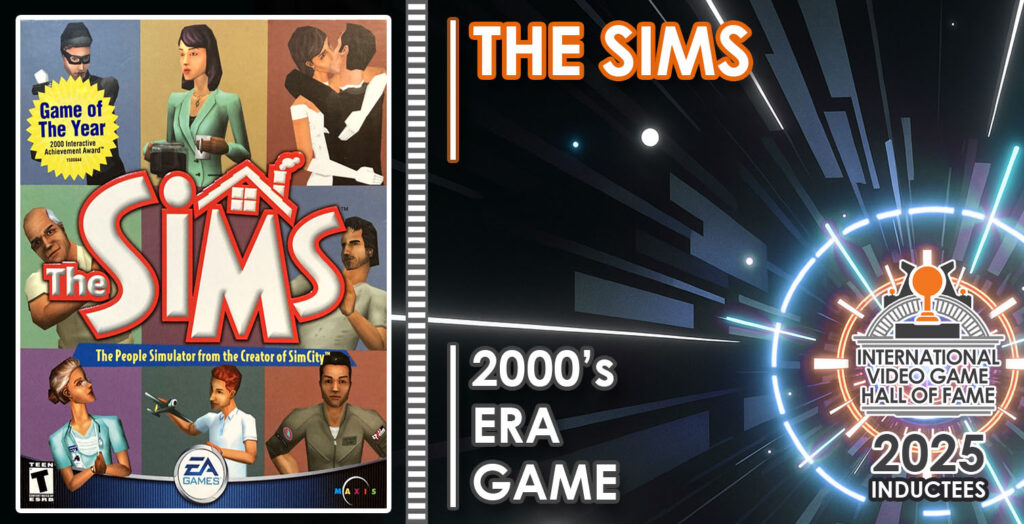
The peak of the ultimate sandbox design trend, The Sims reinvented what is considered possible through gamification, and created an innovative experience that proves that even mundane, everyday tasks can be fun when delivered in the right way.
After cementing his name in interactive simulations with previous genre-defining successes SimCity, SimAnt, SimEarth and SimTower experiences, renowned game designer Will Wright set about to gamify life’s everyday experiences.
Taking inspiration from the core concepts of SimCity and an obscure C64 game, Little Computer People, The Sims succeeded in turning ordinary life into an open-ended daily adventure. The goal was to showcase the common, daily routine, including decorating, managing mood swings, and yes, even going to the bathroom, as an entertaining activity.
After losing his house a firestorm in 1991 and having to rebuild as a result, thinking about the game-potential aspects of that rebuilding, ended up being some of the core inspiration. Originally pitched as a ‘virtual doll house,’ the pitch really didn’t do justice to the depth of interactions and activities present within the experience, quickly evolving into satire of US consumer culture and our inherent focus of our obsession of ‘things.’
The final game was released on February 4, 2000, and by 2002 had sold through expansion packs and deluxe editions over 6 million copies worldwide, cementing its place in the pop culture conversation. It also surpassed Myst as the best-selling PC game in history at the time. By 2005, over 16 million copies were in happy consumer’s hands. Today, with all iterations combined, The Sims is responsible for approximately 50 million units of sales and recognized by the Guinness Book of World Records as one of the ‘Best Selling PC Game Series.’ It also attained the achievement of being one of the top 10 best-selling video game franchises of all time.
The Sims and all its sequels became a multi-billion-dollar franchise for Electronic Arts, spawning spinoffs, themes, and goal-driven experiences. The franchise is still in active development at the time of induction with Sims 4, showing the popularity and innovation of this sandbox-of-life simulation, still relevant even 25 years after its original introduction.
Many have tried to copy the style of gameplay introduced here, but only The Sims has created its own genre, legacy, and category, which it still owns and continues to entertain and delight with each new generation.

William “Trip” Hawkins stands as a monumental figure in the history of the video game industry; a visionary entrepreneur whose influence shaped not only the creative and business landscape but also the very way games are developed and perceived. A graduate of Harvard and Stanford, Hawkins was an early employee at Apple, where he served as Director of Strategy and Marketing. This experience with the burgeoning personal computer industry laid the foundation for his groundbreaking vision.
Founding Electronic Arts in 1982, Trip Hawkins professionalized publishing, championed crediting “software artists” as worthy of recognition and respect and built systems that elevated creators the way record labels highlighted individual musicians. This included pioneering practices like including prominent developer credits and high-quality packaging that elevated video games from a niche hobby to a form of mainstream entertainment.
He also sparked modern sports gaming by conceiving the Madden NFL franchise and seeding what became EA Sports and one of the most successful game series of all time — proving that authentic simulation, celebrity partnerships, and annualized live-service thinking could define a gaming culture for decades.
Never content to rest, Hawkins pushed new platforms and business models by founding The 3DO Company to pioneer a licensing-led console strategy and later founding Digital Chocolate, an award-winning early leader in mobile gaming—demonstrating prescient bets on where players would be next.
His career-long pattern—identifying the next medium, empowering talent, and building durable franchises—has already been recognized by the Academy of Interactive Arts & Sciences Hall of Fame. Trip Hawkins’ career is indeed a testament to the power of a singular vision, demonstrating a profound and enduring influence that has affected countless game developers and players alike.
This Walter Day Lifetime Achievement Award fittingly recognizes the breadth and lasting impact of his vision across PC, console, and mobile, fundamentally reshaping video games as both an art form and a global industry.
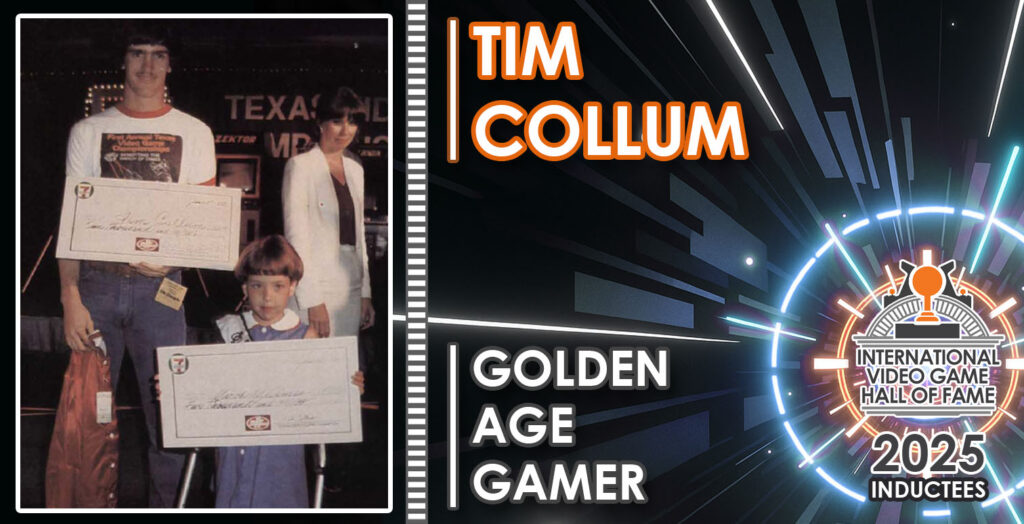
A competitive pioneer and proven champion in the game industry’s Golden Age, Tim Collum stands as a prime candidate for induction based on his early contributions to competitive gaming history and undeniable feats of excellence.
Collum’s career is defined by a series of major victories that solidified his reputation as one of the era’s elite players. His journey began with a commanding victory at the Texas Video Game Championship in June 1982, a regional success that was a prelude to a much larger triumph. The crowning achievement came a few months later when he won the highly publicized ‘That’s Incredible! Ms. Pac-Man Tournament’ to international viewership. This was no small feat with qualifying rounds held at Six Flags amusement parks across the country and a televised finals reaching a broad audience. Collum’s championship-winning score of 123,000 not only demonstrated his exceptional skill in a very constrained, high-pressure environment, but also showcased the strategic depth of competitive gaming to a mainstream audience.
In addition to his tournament victories, Collum’s legacy is further cemented by his specific high scores including his dominance on classics such as Sega’s Congo Bongo. His noted world record score of 883,400 held for decades at Twin Galaxies International Scoreboard—which, at the time, placed him as one of the top-ranked players on the global level.
Beyond his specific records, Collum’s impact is solidified by the recognition he received from the competitive gaming community itself. At the Twin Galaxies 1984 Coronation Day event, he was honored as co-player of the year for 1983, a title that placed him in the top tier of competitive gamers globally. This peer and industry recognition confirms his status not just as a skilled individual, but as a central figure in the formative years of organized, competitive gaming. His career embodies the sportsmanship and skill that define the very essence of the pioneering efforts of a Golden Age Gamer.
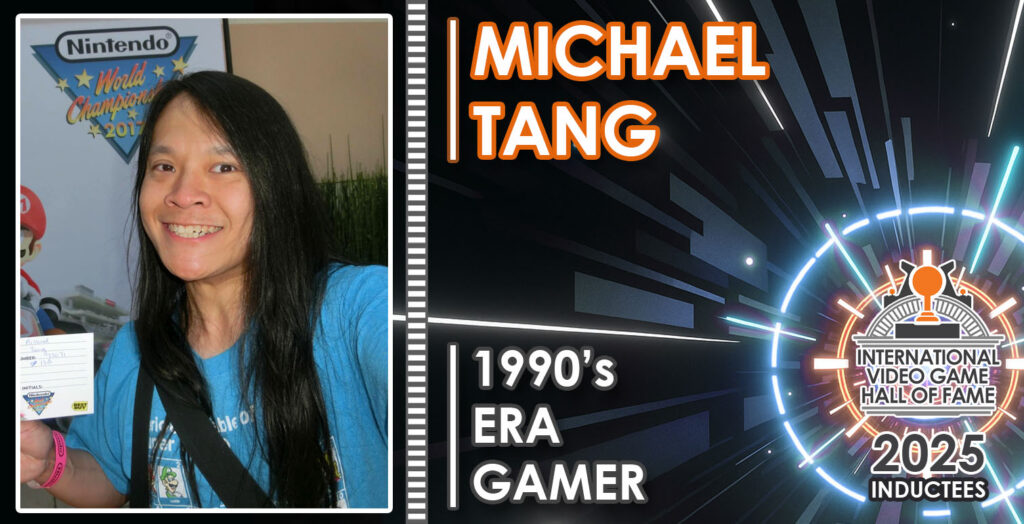
Michael Tang deserves induction into the International Video Game Hall of Fame as a documented 1990s national champion who helped define—and quietly elevate—the standards of console competition in that era. Period testimony confirms he won the Howard Johnson (HoJo) National Championships on Sonic the Hedgehog 3, a wide-reaching Sega-backed program that toured North America and put hotel-chain qualifiers and finals on the same map as the better-known publisher events of the day.
Tang then leveraged that mastery to coach and strategize with his brother Chris ahead of Sega/MTV’s landmark 1994 Rock the Rock finals on Alcatraz, directly influencing one of the decade’s most iconic victories. In addition to those key victories, Michael has also achieved tournament champion at other high-profile tournaments of that era including: Kids Go Hojo with Sega (1993), Kids Go Hojo with Sega (1994), Funcoland National Video Game Championships (1996) and the Konami Gradius V Championship (2004).
It is clear that his championship caliber tournament play, including the records of his HoJo national titles and the scale of the HoJo Sega circuit, attest to a champion operating at the highest tier of 16-bit competition. Making an outstanding impact on the scene and one of its marquee champions, Michael Tang is exactly the kind of athlete-mentor whose achievements and influence the IVGHOF was created to honor.
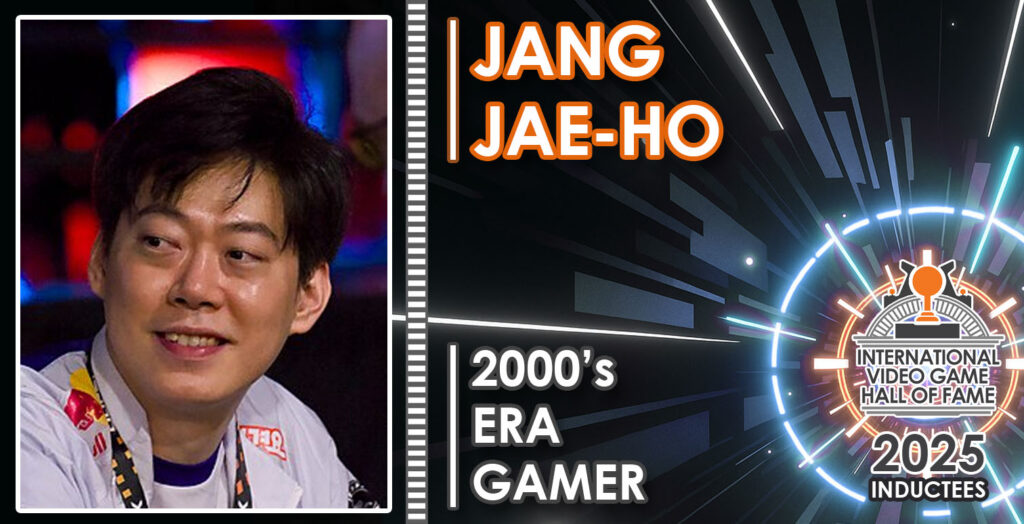
Jang “Moon” Jae-ho inscribes his name in esports history as a transcendent strategist and pioneering icon—a five-time World Champion and record-setting virtuoso in Warcraft III. His extraordinary mastery over the Night Elf race earned him the legendary moniker “The Fifth Race” for revolutionizing core gameplay with innovative openings and micromanagement which became the genre’s gold standard. Between 2003 and 2008, he dominated both Korean and global stages—clinching nine MBC Game League titles, back-to-back World e-Sports Games, multiple IEST championships, and national honorifics like KeSPA’s “Greatest Player.”
His unmatched competitive creativity—cultivating strategies such as mass Druids of the Talon, tower rushes, and tri-hero lineups—reshaped how Night Elf was played worldwide. Even after a military service hiatus, Moon returned to seize glory once more with a victory at the 2018 WGL Winter Grand Finals, underlining his enduring legacy across eras. He remains not just a legend, but an ongoing force in esports—definitively earning his place in the International Video Game Hall of Fame.

Tim Sweeney stands as one of the most influential industry leaders in video game history—a visionary whose innovations have reshaped not just how games are made, but how they are played, distributed, and monetized worldwide. As the founder and CEO of Epic Games, he created Unreal Engine, a development platform so powerful and versatile that it has become the backbone not only of blockbuster video games but also of film, architecture, and virtual production industries. Under his leadership, Epic transformed from a modest shareware studio into a global powerhouse, launching cultural phenomena Unreal Tournament, Gears of War, and Fortnite. These iconic titles redefined online play, esports, and the free-to-play model while pioneering new standards in cross-platform gaming.
Tim and Epic have also been recognized by the Academy of Interactive Arts and Sciences, the Game Developers Choice Awards and Forbes Media for his ongoing contributions and innovations within the interactive entertainment industry.
In addition to his pioneering feats within the video game industry, his philanthropic efforts are focused on conservation within South Carolina, buying and donating large tracks of land to protect wilderness and indigenous species.
Sweeney has also been a relentless advocate for developers, challenging entrenched digital storefront monopolies and fighting for fairer revenue models through the Epic Games Store. His bold mix of technical genius, entrepreneurial risk-taking, and commitment to empowering creators makes him a definitive choice for the International Video Game Hall of Fame’s Industry Leader category.

Games Done Quick (GDQ) is a video game organization that has transcended its origins to become a globally recognized cultural and philanthropic institution, all focus around promoting the art of interactive entertainment. Founded by Mike Uyama in 2010, GDQ began as a small, online speedrunning event and has now grown in scale to international, bi-annual marathons that unite thousands of gamers, viewers, and commentators for a singular purpose: to use the spectacle of video games for the greater good.
It all started as “Classic Games Done Quick,” a small gathering of speed runners from the Speed Demos Archive community. The inaugural event, held from a private residence, raised a little over $10,000 for a charity. This humble beginning set the stage for what would become an international phenomenon demonstrating the power of community. The events, Awesome Games Done Quick (AGDQ) and Summer Games Done Quick (SGDQ), are now a cornerstone of the gaming calendar, drawing hundreds of thousands of concurrent viewers and featuring a rotating schedule of elite speed runners showcasing their incredible skill.
The primary mission of Games Done Quick is to leverage the art of speedrunning for charitable causes. These events have collectively raised over $56 million for a variety of charities, with a focus on the Prevent Cancer Foundation and Doctors Without Borders. GDQ’s fundraising model is innovative and highly engaging, allowing viewers to donate money to unlock special incentives, such as having a runner attempt a harder challenge, naming a character in a game, or choosing a new game for a bonus run.
Throughout its tenure, GDQ has also supported a wide range of other organizations, including the Malala Fund, AbleGamers, Direct Relief, The Trevor Project, and the National Women’s Law Center— often through special or smaller-scale events. This direct, interactive relationship between the audience and the content creators transforms passive spectatorship into an active, philanthropic experience.
Beyond the numbers, GDQ’s impact on video game culture is profound. GDQ shares responsibility in elevating speedrunning from a niche hobby to a form of public performance and a celebrated competitive art form. The organization fosters a diverse and inclusive community, providing a welcoming platform for people of all backgrounds through dedicated sub-communities like Frame Fatales and Black in a Flash. The events are also known for featuring iconic speedrun games like Super Metroid, Celeste, and The Legend of Zelda: Ocarina of Time, as well as modern blockbusters like Elden Ring, and even creative runs where players use instruments or other unique controllers.
Through its events, GDQ has demonstrated that video games are not just a form of entertainment, but a powerful medium for positive change, proving that a shared passion can lead to meaningful and positive real-world impact across the globe.
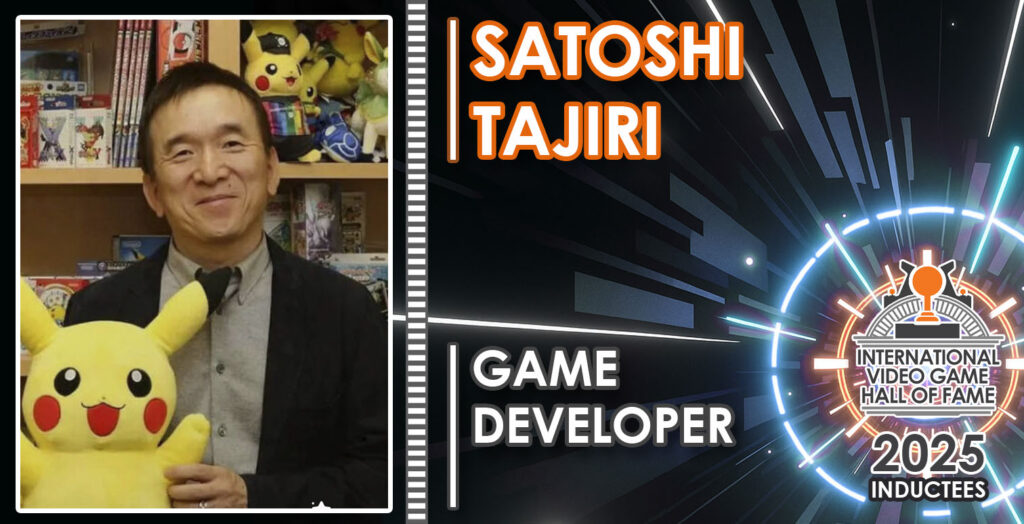
Satoshi Tajiri’s visionary work has not only created one of the most enduring and profitable entertainment franchises in history but has also profoundly reshaped the landscape of what a video game franchise could be.
Tajiri’s journey into game development began not in a formal school, but in the fields of his hometown, where he spent his childhood passionately collecting insects. This hobby, which earned him the nickname “Dr. Bug,” became the foundational inspiration for a groundbreaking concept.
That concept, the Pokémon franchise, was born from a simple-yet-revolutionary idea built off of his bug-collecting passion. Inspired by the Game Boy’s Link Cable, Tajiri envisioned a game that would allow players to connect and trade creatures, recreating the feeling of collecting and exchanging bugs from his youth. The development of Pokémon Red and Pokémon Green was a grueling, six-year process that nearly bankrupted Game Freak, the development company he started from its fanzine roots, but the risk paid off spectacularly.
Upon its release in 1996, Pokémon for the Game Boy was an instant sensation. The game’s success was not just a commercial win, it introduced a new paradigm of gameplay centered on collecting, training, and social interaction through the innovative use of the Link Cable. This focus on connectivity and trading, rather than just head-to-head combat, fostered a sense of community and cooperation that was rare in gaming at the time.
Tajiri’s initial creation as well as all future expressions have since become a global phenomenon. The Pokémon franchise is now the highest-grossing media franchise of all time, with an estimated total revenue of over $147 billion. This incredible financial success spans a diverse range of media, from video games and the hugely popular Trading Card Game to anime, movies, and toys. The original video games alone have sold hundreds of millions of copies, with the entire series being one of the best-selling of all time.
Beyond the numbers, Tajiri’s influence on the game industry and the evolution of design is immeasurable. The Pokémon games pioneered the “collectathon” genre and proved the commercial viability of RPGs on handheld devices. More importantly, the franchise’s emphasis on social connection and shared experiences set a precedent for a generation of games that followed, making it one of the most influential franchises in modern entertainment. His ability to translate a simple childhood hobby of bug collecting into a complex, intricate, and universally beloved world demonstrates a rare and invaluable creative genius.
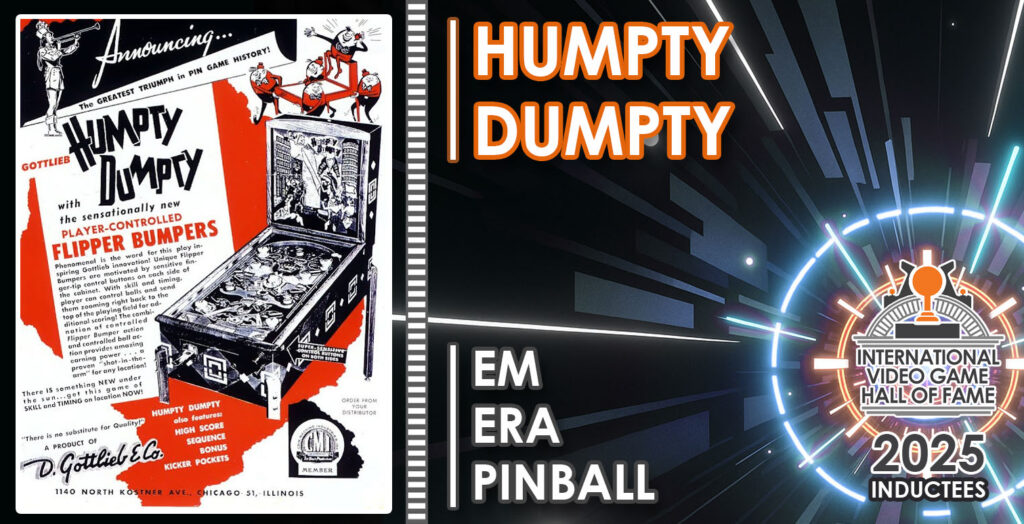
Humpty Dumpty, a groundbreaking electro-mechanical pinball machine, deserves a place in the International Video Game Hall of Fame not just as a historical artifact, but as a foundational pillar of modern interactive entertainment. Its revolutionary innovation single-handedly transformed an entire genre and laid the groundwork for every pinball machine that has followed.
Released by D. Gottlieb & Co. in 1947, and designed by the visionary Harry Mabs, Humpty Dumpty was the first game to introduce player-controlled flippers. Before this moment, pinball was largely a game of chance, where players would launch a ball and watch it ricochet down a sloped playfield. Mabs’ ingenious addition of six small, outward-facing flippers which Gottlieb marketed as “flipper bumpers,” put control directly in the player’s hands. This shifted the entire experience from a passive observation to an active engagement, introducing a crucial element of skill that is now synonymous with the game.
The legacy of Humpty Dumpty is immeasurable. While its flipper design was soon refined with the now-standard inward-facing flippers at the bottom of the table, the core concept introduced the ability for a player to send the ball back up the playfield and became the central principle of pinball. It meant that a game could be extended indefinitely by a skilled player, creating a deeper, more rewarding challenge.
Every multi-ball frenzy, every high-scoring combo, and every epic comeback on a modern pinball machine owes its existence to the simple, yet profound, innovation of Humpty Dumpty. For giving the game its heart and soul, it is unequivocally deserving of this prestigious honor.
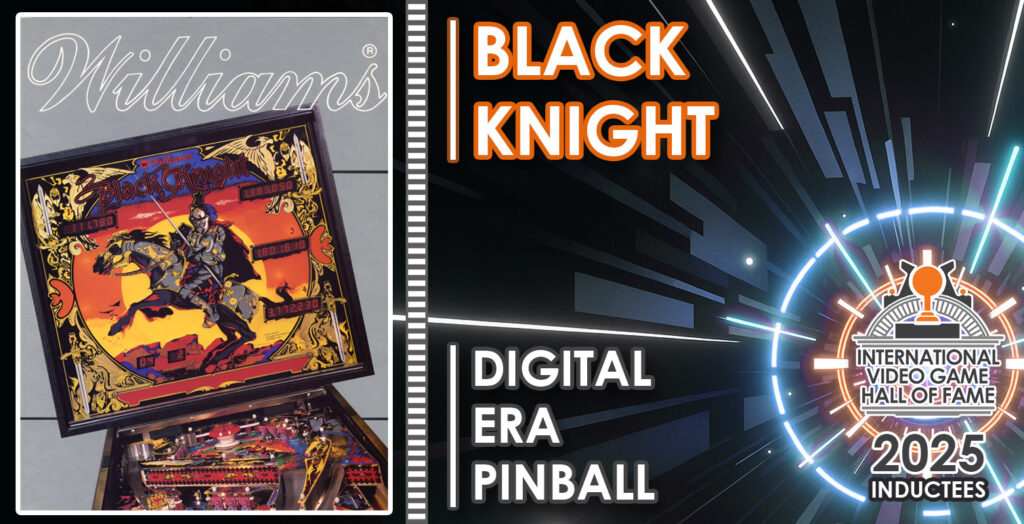
While video games often claim the spotlight for innovation and cultural impact, the medium of pinball has produced its own legends, and none is more deserving of a place in the International Video Game Hall of Fame than Black Knight. Released by Williams in 1980, this machine was a revolutionary force that single-handedly changed the trajectory of pinball design. Its induction honors both a masterpiece of engineering as well as acknowledges the profound influence it had on the entire solid-state era and beyond.
The history of Black Knight is inextricably linked to its legendary designer, Steve Ritchie, often referred to as “The King of Flow.” Released by Williams in the early days of solid-state electronics, the machine was an immediate commercial success, with over 13,000 units produced. This high production number for the time was a testament to its widespread appeal and foundational importance. Black Knight was a bold statement, pushing the medium forward with a dark, medieval theme and a level of intensity previously unseen in pinball.
The true genius of Black Knight lies in its multiple and revolutionary innovations. The game was the first to feature a two-level playfield, with an upper level accessible via ramp shots. This specific innovation introduced a new verticality and complexity to pinball, fundamentally altering the way designers approached layout as from this point forward pinball was no longer ‘flat.’ Equally groundbreaking was the “Magna-Save” feature, which was a player-activated magnet that could catch a draining ball on either outlane, offering a new level of player control and strategic depth previously unseen. Black Knight also advanced the use of synthesized speech in pinball, giving the game a menacing, iconic voice that brought the titular character to life and created an unprecedented sense of immersion as you battle the Black Knight for dominance.
The profound impact of Black Knight on the pinball industry cannot be overstated. The two-level playfield became a hallmark of many subsequent Williams games and was widely emulated by other manufacturers, defining an entire generation of pinball design. The Magna-Save feature, while not universally adopted, was a key influence on player-controlled mechanics and remains a signature element of many of Steve Ritchie’s designs. Furthermore, the successful integration of speech in Black Knight made voice callouts a standard feature in high-end pinball machines for years to come.
The game’s fast-paced, high-risk, high-reward gameplay and aggressive theme set a new tone, proving that pinball could be a challenging and intense experience for skilled players. For its role in inventing new features, establishing new design paradigms, and defining an entire era of the medium, Black Knight stands as a rightful icon of interactive entertainment.
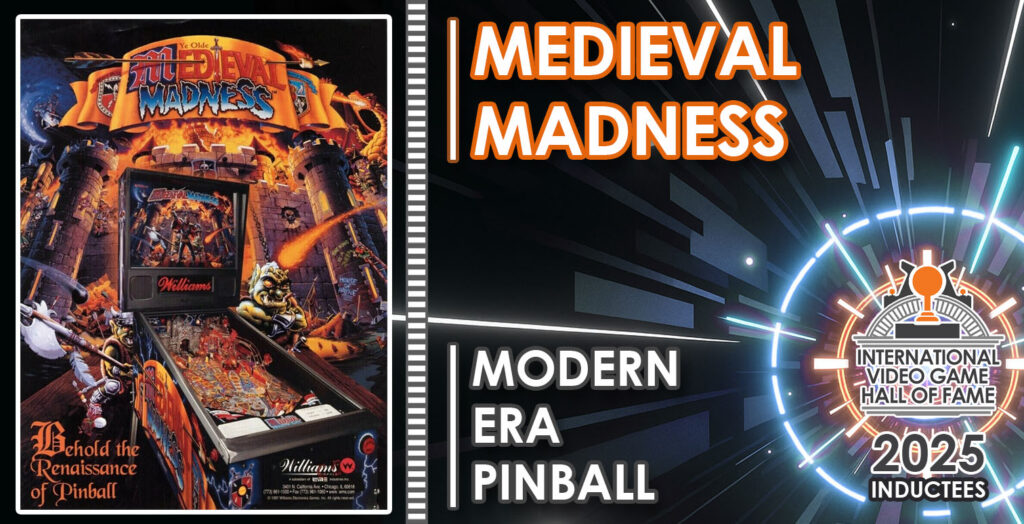
While video games often claim the spotlight for innovation and cultural impact, the medium of pinball has produced its own legends. Released by Williams in 1997, Medieval Madness represents the pinnacle of pinball design, blending accessible gameplay with groundbreaking features and a timeless sense of humor. Its induction honors a masterpiece of mechanical and artistic engineering and also acknowledges the profound influence it projected on all pinball machines that followed.
The history of Medieval Madness is a testament to its quality. Designed by the legendary Brian Eddy, with assistance from George Gomez on the complex mechanical castle, the game emerged at the tail end of pinball’s initial heyday. .” Its initial production run was a modest 4,016 units, but it quickly developed a reputation that far outstripped its numbers. This scarcity, combined with its perfect execution, transformed it from a popular arcade machine into a coveted collector’s item and a perpetual top contender in pinball enthusiast rankings.
The true genius of Medieval Madness lies in its innovations, which elevated the entire Pinball experience. The game’s central feature, an animated, “exploding” castle with a motorized drawbridge and solenoid-controlled portcullis, was a stunning mechanical achievement. This interactive toy provided a clear, satisfying, and deeply rewarding objective for players of all skill levels. Equally notable were the two pop-up trolls that rise from the playfield to taunt the player, creating dynamic and surprising moments. These elements, combined with witty, humorous voice acting by an ensemble cast that included actress and comedian Tina Fey, created a narrative and theatrical experience that was both immersive and endlessly entertaining.
The profound impact of Medieval Madness on future pinball design cannot be overstated. It perfected the “package” approach, proving that a cohesive, family-friendly theme, combined with intuitive rules and spectacular mechanical toys, could be the key to mass appeal. It set a new standard for accessibility, with a simple primary objective that new players could immediately understand, while simultaneously offering deep rules and multi-stage multiball modes for seasoned veterans. Its success showed that pinball could thrive not just through technical complexity, but through charm, wit, and a seamless integration of art, sound, and gameplay.
The game’s enduring legacy is its influence on modern pinball. Subsequent designers have often sought to emulate its perfect balance of flow and targets, and its success spurred a vibrant aftermarket of remakes that continue to sell out, proving that its design principles are as relevant today as they were when it was created in 1997. For its role in perfecting the craft and defining the future direction of the medium, Medieval Madness stands as a rightful icon of interactive entertainment and a deserving member of the International Video Game Hall of Fame.
#####