The Inception of Digital Fun…
An arcade was destination entertainment. It was the place you went to visit your favorite video game, and if you had the time and money, drop a quarter for a single use experience and possibly strive to make it on the high score board with other elite players.
If that high score board had permanent or battery backed high scores, others that came along would also be able to recognize your feat as the results of your experience stayed on that game for all to see.
As the industry evolved, video games managed to come home, through standalone hardware decks or those that took individual cartridges. In this case the cartridges were interchangeable and played on any hardware platform it was designed to support. This created a generation that grew up with not just the driving force of arcade games, but of the era of the classic consoles with Atari 2600, Coleco Vision and Intellivision reigning supreme.
In the early days, no one was quite sure if the game industry was just that, an industry, as many thought this movement was a fad and might have run its course in the mid 80’s, but then Nintendo came along and literally told everyone video games were here to stay. The NES, Master System, Genesis, SNES, and many others paved the way through the 90’s and beyond with physical cartridge-based gaming.
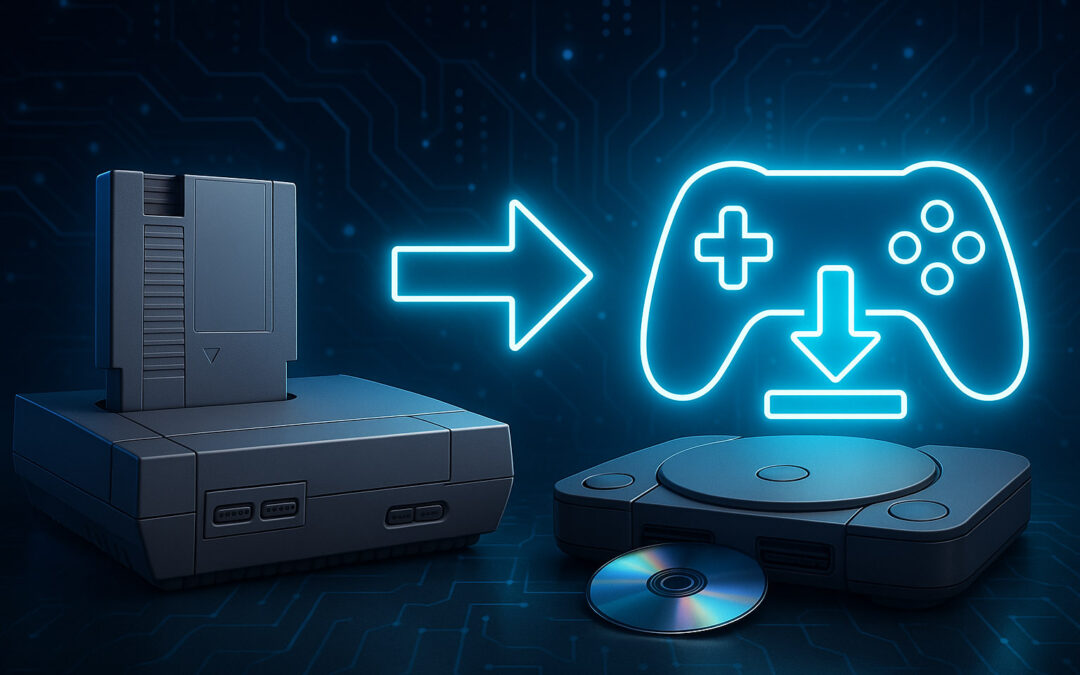
The next evolution came with the advent of the CD-ROM and the floppy disc, same type of physical distribution for individual video games, but slightly different format that held more data and cost far less to produce. The N64, PlayStation, Saturn, Dreamcast, GameCube and others continued to pave the way here, continuing the distribution of games in physical packages.
The key thing for all gaming, including the large-scale arcade cabinets, is that video games, although digital in experience, were all physical in their creation and distribution. You would wake up on Christmas Day with highly sought after video games under the tree, just waiting to be opened and played for endless hours.
Now, for the industry to continue growing, innovation needs to drive things, as we all want the ‘new’ the ‘special’ the ‘unique’ and video games have always been a perfect medium to deliver that experience, whatever that world, theme or setting may be.
That innovation brought us to smart phones, which clearly includes gaming, the MMO and the advent of, heaven-forbid, free-to-play gaming. All fun and pushing an industry forward in terms of experience and business models, but with one key change; you no longer own a tangible, physical package or box, disc or cartridge that might contain that precious game.
Digital distribution quickly evolved as it was a much quicker, much cheaper and faster way to get games to, well, gamers.
No longer do gamers need to go to the store or wait in line or pre-order or wait for the mail, in order to make a decision of a game you want to play. The time from decision to playing has gotten ridiculously small, in fact. It’s too easy now to be talking about a game with some friends and immediately download the same game to your phone mid conversation. No barriers, no disruptions, and in many cases, no costs either.
The Evolution of an Industry…
So far all this sounds absolutely fantastic as an evolution to the medium. Publishers and developers love it because they make more profit through digital distribution models and players love it because, well, its instant gratification. Just make decision and click download. No longer do you have to go through the process of: make decision, find car keys, get in car, realize it’s out of gas. Grumble to self while driving to gas station hopefully on the way to Best Buy. Walk into store. Spend an eternity trying to find the game on the shelf to purchase. Spend another eternity trying to find an employee that can open the glass and get you a copy to buy. Wait in line at register, never patiently. Run, don’t walk, back to car to hurry to get home. Pull into driveway while crashing into the trash can. Dash into living room. Argue with sister to turn off the home improvement channels so you can have the living room big screen. Attempt to open the cellophane with your hands and eventually give up looking for scissors that never reside in the same place twice. Put the Blu-ray into the console. Wait for the dashboard to load. Wait for the game to load. Wait 40 minutes, arguing with same sister, for the day one 100Gb patch to download then install. Finally, time to Press Start. (heavy sigh)
Digital downloads clearly make the best case for the better consumer experience in our ADHD, I want it ‘now’ culture.
Having said all that, in a world where we constantly strive to learn from history and preserve it, how do you store a game that you downloaded digitally, and the developer has turned off the server?
With this new model, if the developer or publisher decide the game has run its course, they can throw the switch and make the servers that run and drive the game, simply disappear. Even if you still have the original download; no server, no play.
I still have my N64 and the cartridges still plug into the console and they still work. Same with my NES, Vectrex, Atari 7800 and other classic consoles. In fact, buying and selling classic, ‘physical’ games has become big business. GameStop, for example, existed initially so serve this market alone. eBay makes hundreds of millions on physical video games being bought and sold every year. Classic gaming conventions have become places for fans of the classics to buy, sell, trade and even create. Believe it or not, new Atari 2600 and NES titles are still being made today by a very large fan community.
But what about today’s digital spectrum. Each day, we are now losing countless video games, many without so much as a whimper or sound. They simply get turned off or removed from stores or OS upgrades make them obsolete and they no longer work.
The largest art form in the world, has somehow became disposable.
Film has a great business model by contrast; make a movie, keep selling and reselling it for decades and decades. The recent streaming systems have even embraced this model as a new way for old catalogs of movies to have a new life with a new audience.
Video games as well have found new audiences through emulation and compilations of older games, put into MAME cabinets and countless software hardware emulators that keep the past alive and playable in various legal and some grey area productions.
Our early past is secure. We know how to find those games, how to plug them in, how to restore them, emulate them and of course, how to play them. Today’s games fit none of these patterns or criteria.
Sony, for example, cancelled a $400 million live service game called CONCORD after only operating it for 2 weeks. No idea if the game was good, bad or fun to play, but we’ll never have the chance to find out. This very expensive game will go the way of urban myth and gamers will tell stories of those fortunate enough to have at least played it once before the switch was flipped, and Concord disappeared with the giant cosmic flushing sound, deep into the black abyss.
I still have this amazing steel case, collector’s edition of EA’s Warhammer MMO from about 15 years ago. Great packaging, beautiful concept art book, and lots of discs, that for all intents and purposes do absolutely nothing. Without the servers to control it, the game cannot be played. So, although I do have a physical copy, it is relegated to a mere curiosity on the bookshelf.
If you are a gamer, you’re playing one or more digital live services today. You’ve probably invested more time than money in the experience, or perhaps you’ve reversed that equation. Think to yourself, now that it’s part of your lifestyle, what if the powers-that-be decide it’s no longer profitable for them to run and just turn it off. Will you take it well and remind yourself you knew the risks when you started playing, or end up in the fetal position that that part of your life is now over?
To go even further, what if Valve for some odd unexplainable reason I can’t possibly think of at the moment, went out of business and shut down Steam? For all the Steam users, that means that your entire game collection that you invested years of bulk-buying from Steam sales, just went ‘poof’, not to mention that your coveted friend connections would also go ‘poof’.
What Do We Do When a Game is Turned Off?
On a macro view, as an industry, how should we handle such situations, as we are in the middle of this current phase of our evolution, and we’re losing games to the hungry black abyss every day as a result.
Yes, it’s one thing to lose a crappy mobile game that nobody plays and even fewer people knew existed in the first place, but that’s less of the point. If you look back at the classics, even the bad games are fun to try out and relive what came before.
We also have the same issues with successful games. Tetris Blitz was a highly successful mobile version of the classic game of Tetris and had hundreds of millions of downloads to show for its successful seven-year run. Today, nobody can play it as it was turned off in 2020, victim more of licensing agreements running their course rather than players not having fun or investing in the game. There are some YouTube videos that remind people what it was, but there is currently no way for anyone to play the game again, and no path in sight to make that happen through emulation, simulation or development magic.
The key here is to decide first if this is a problem or not. Porting games to endless additional platforms is a good business model. Distributing games on as many digital services that exist within the purview of the internet is also a great financial decision. Back to the lowly Concord, its two weeks of public scrutiny is all it’s ever going to get. It’s gone the way of the dodo, or at best Monty Python’s dead parrot. It may also be kept alive as a cautionary tale in the industry of overspending or not understanding what you’re making or even who your audience is, but still, no one will be able to play it.
Picture us as an industry just 10 years from now. Think of how many games we’ll have lost to the cosmic ‘off’ switch. I can sit with my kids and play with them, the games I grew up with and have fun with the experiences all over again, but those growing up on Fortnite may not have the same luxury if players get bored of Fortnite and Epic moves on.
Perhaps this is one of those ‘take-a-breath’ moments where we pause and really think about where we want to be and how we want to recognize the history of our industry and celebrate everything that helped to shape it to what it is today. The next generation is going to miss out on quite a bit in fact.
The movie industry can still play a movie that was made 100 years ago, but in 10 years, we won’t be able to play most games made in 2025, unless they are still alive and no one has pulled the plug yet.
Nintendo is probably the last holdout here as both with the Switch and Switch 2, they are still seeing the relevance and importance in developing, selling and allowing physical games to flourish, with stand-alone modes that will allow them to work independent of server connectivity or other external technical influence. Nintendo has always had success in this way, so it makes sense they are the last holdout and we should applaud them for it. I think gamers have already had a say in this as the Switch is still the number one console in the world with over 150 million units sold (for comparison, the PS 5 is 1/3 that).
I’ll ask the key question then, “Are we ok with all of this?”
There’s lots of answers to this coming from vastly different perspectives. There’s also various groups pushing for movements for games to allow for archiving or offline modes or allowing emulation of copyrighted material once it has run its course. They are all valid movements and initiatives, but need more groundswell to take shape. I also think if there is change to happen, it will come from the grassroots, the gamers themselves, demanding preservation, emulation or whatever is necessary to play a ‘today’ game that has been turned off, and still be able to play it again ‘tomorrow’.
If there was a business model in the preservation of interactive content, then the publishers would be all over it and supporting it, so perhaps creating and supporting a revenue stream can help push the needle a bit.
The last thought for today is more of a ‘what if’ addressed to developers, publishers and gamers, as those are the three audiences that make up this entire phenomenal industry.
What if we continue to let games disappear? Should we be following Nintendo closer or make a point that all games going forward should always have a mode that is ‘playable’ regardless of middleware, servers and the dreaded ethereal OFF switch.
They say recognizing you have a problem is the first step, so perhaps this musing is a first step at identifying a problem. If we agree that’s it’s a problem then we certainly have a vast and creative community to help solve it as well. Perhaps there’s even a Smithsonian of video games in our future.
In the meantime, I’ll happily go down to my basement and play another game of Robotron: 2084, still in its original arcade cabinet, that plays exactly the same way it did in 1980, and that’s a good thing.