

Medieval Madness
Modern Era Pinball
Class of 2025 Inductee
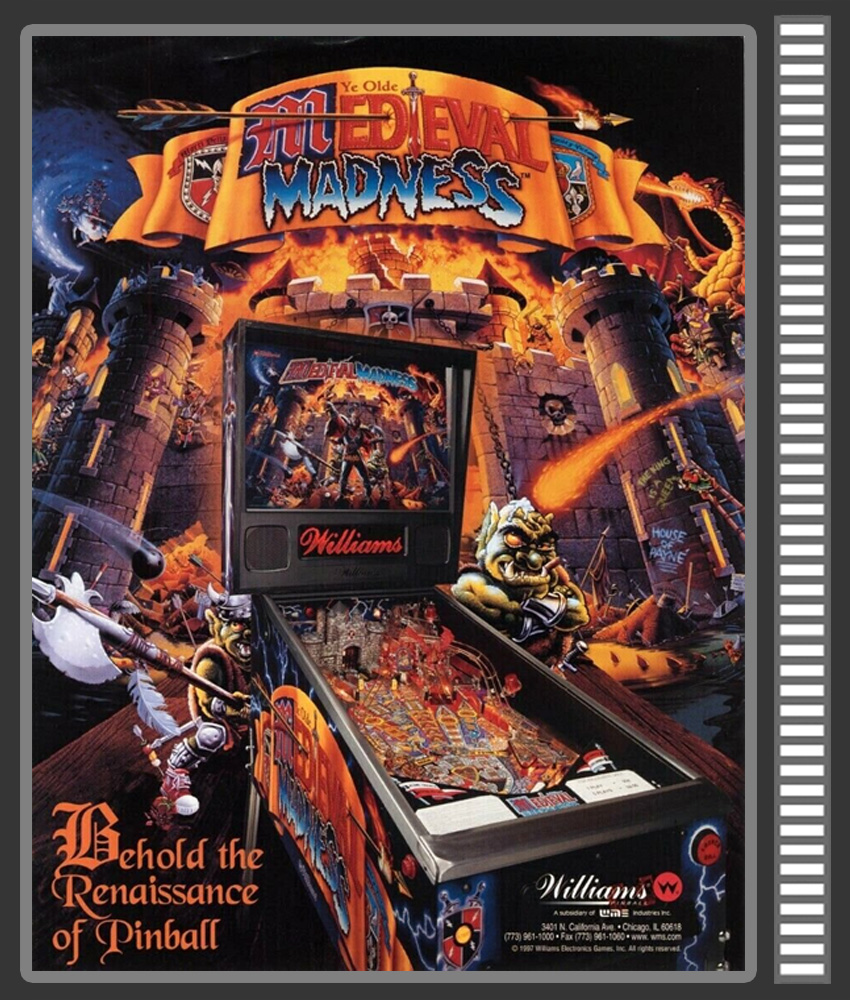
While video games often claim the spotlight for innovation and cultural impact, the medium of pinball has produced its own legends. Released by Williams in 1997, Medieval Madness represents the pinnacle of pinball design, blending accessible gameplay with groundbreaking features and a timeless sense of humor. Its induction honors a masterpiece of mechanical and artistic engineering, and also acknowledges the profound influence it projected on all pinball machines that followed.
The history of Medieval Madness is a testament to its quality. Designed by the legendary Brian Eddy, with assistance from George Gomez on the complex mechanical castle, the game emerged at the tail end of pinball’s initial heyday. Its initial production run was a modest 4,016 units, but it quickly developed a reputation that far outstripped its numbers. This scarcity, combined with its perfect execution, transformed it from a popular arcade machine into a coveted collector’s item and a perpetual top contender in pinball enthusiast rankings.
The true genius of Medieval Madness lies in its innovations, which elevated the entire pinball experience. The game’s central feature, an animated, “exploding” castle with a motorized drawbridge and solenoid-controlled portcullis, was a stunning mechanical achievement. This interactive toy provided a clear, satisfying, and deeply-rewarding objective for players of all skill levels. Equally notable were the two pop-up trolls that rise from the playfield to taunt the player, creating dynamic and surprising moments. These elements—combined with witty, humorous voice acting by an ensemble cast that included Tina Fey—created a narrative and theatrical experience that was both immersive and endlessly entertaining.
The profound impact of Medieval Madness on future pinball design cannot be overstated. It perfected the “package” approach, proving that a cohesive, family-friendly theme, combined with intuitive rules and spectacular mechanical toys, could be the key to mass appeal. It set a new standard for accessibility, with a simple primary objective that new players could immediately understand, while simultaneously offering deep rules and multi-stage multiball modes for seasoned veterans. Its success showed that pinball could thrive not just through technical complexity, but through charm, wit, and a seamless integration of art, sound, and gameplay.
The game’s enduring legacy is its influence on modern pinball. Subsequent designers have often sought to emulate its perfect balance of flow and targets, and its success spurred a vibrant aftermarket of remakes that continue to sell out, proving that its design principles are as relevant today as they were when it was created in 1997. For its role in perfecting the craft and defining the future direction of the medium, Medieval Madness stands as a rightful icon of interactive entertainment and a deserving member of the International Video Game Hall of Fame.
Wikipedia Link:
Credits:
Manufacturer: Williams
Design: Brian Eddy
Programming: Lyman Sheats
Artwork: Greg Freres, John Youssi
Mechanics: Robert C. Friesl
Music, Sound: Dan Forden
Voices: Tina Fey, Scott Adsit, Andrea Farrell, Greg Freres, Vince Pontarelli, Kevin Dorff
Pinside:
https://pinside.com/pinball/machine/medieval-madness
8.893
Game Design: 9.118
Artwork: 8.723
Sounds/Music: 8.371
Other Aspects: 8.992
Internet Pinball Database:
https://www.ipdb.org/machine.cgi?id=4032
Average User Rating: 8.33 / 10
Art: 8.36 / 10
Audio: 8.25 / 10
Playfield: 8.37 / 10
Game Play: 8.34 / 10