

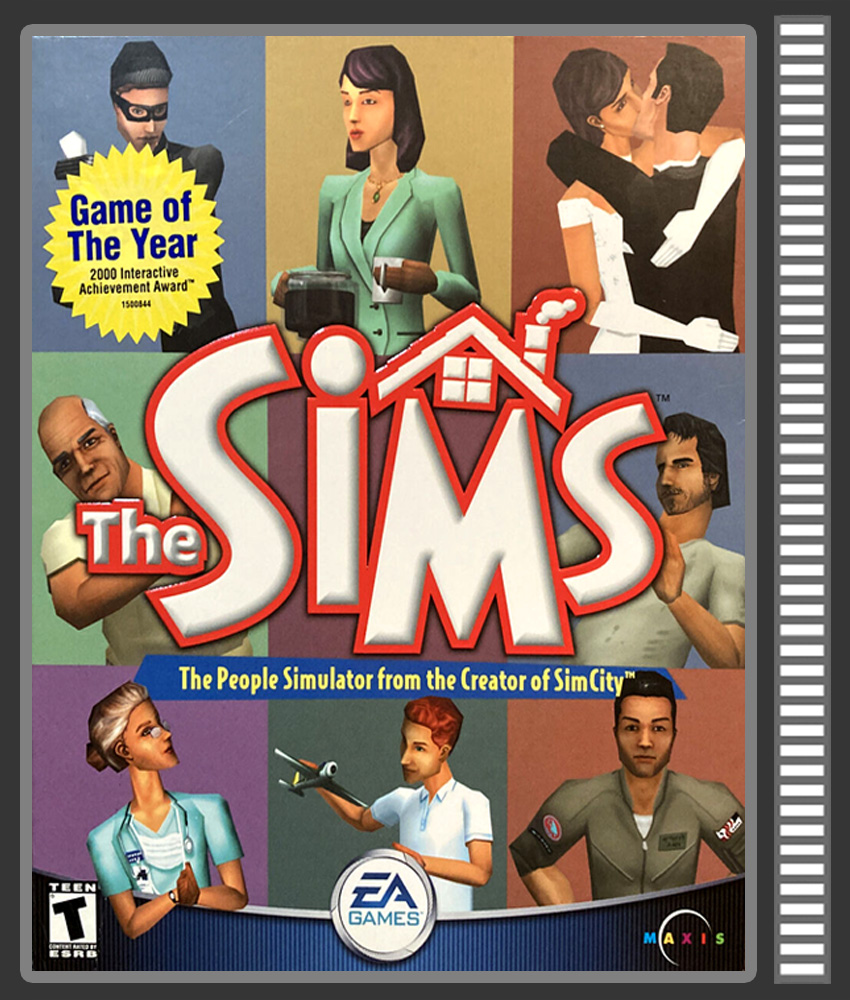
The Sims
2000's Era Game
Class of 2025 Inductee
The peak of the ultimate sandbox design trend, The Sims reinvented what is considered possible through gamification, and created an innovative experience that proves that even mundane, everyday tasks can be fun when delivered in the right way.
After cementing his name in the simulation genre with previous genre-defining successes SimCity, SimAnt, SimEarth and SimTower experiences, renowned game designer Will Wright set about to gamify life’s everyday experiences.
Taking inspiration from the core concepts of SimCity and an obscure C64 game, Little Computer People, The Sims was targeted to turn ordinary life into an open-ended daily adventure. The goal was to showcase everyday life, including decorating, managing mood swings, and yes, even going to the bathroom as an entertaining activity.
After losing his house in Oakland in a firestorm in 1991 and having to rebuild his life as a result, thinking about the game-potential aspects of that rebuilding, ended up being the core inspiration. Originally pitched as a ”virtual doll house,” the pitch really didn’t do justice the to depth of interactions and activities present within the experience, quickly evolving into satire of US consumer culture and our inherent focus on ”things.”
The final game was released on February 4, 2000 and by 2002 had sold̶—through expansion packs and deluxe editions over 6 million copies worldwide, cementing its place in the pop culture conversation. It also surpassed Myst as the best-selling PC game in history at the time. By 2005, over 16 million copies were in happy consumer’s hands. Today, with all iterations combined, The Sims is responsible for approximately 50 million units of sales and recognized by the Guinness Book of World Records as one of the ”Best Selling PC Game Series.” It also hails as being one of the top 10 best-selling video game franchises of all time.
The Sims and all of its sequels became a multi-billion-dollar franchise for Electronic Arts, spawning spinoffs, themes, and goal-driven experiences. The franchise is still in active development at the time of induction with Sims 4, showing the popularity and innovation of this sandbox-of-life simulation, still relevant even 25 years after its original introduction.
Many have tried to copy the style of gameplay introduced here, but only The Sims has created its own genre, legacy, and category, which it still owns and continues to entertain and delight with each new generation.
Wikipedia Link:
Primary Credits:
Developer: Maxis
Publisher: Electronic Arts
Producer: Kana Ryan
Designer: Will Wright
Programmers: Jeffrey Charvat, Jim Mackraz
Artist: Charles London
Writer: Sean Baity
Composers: Jerry Martin,Marc Russo