

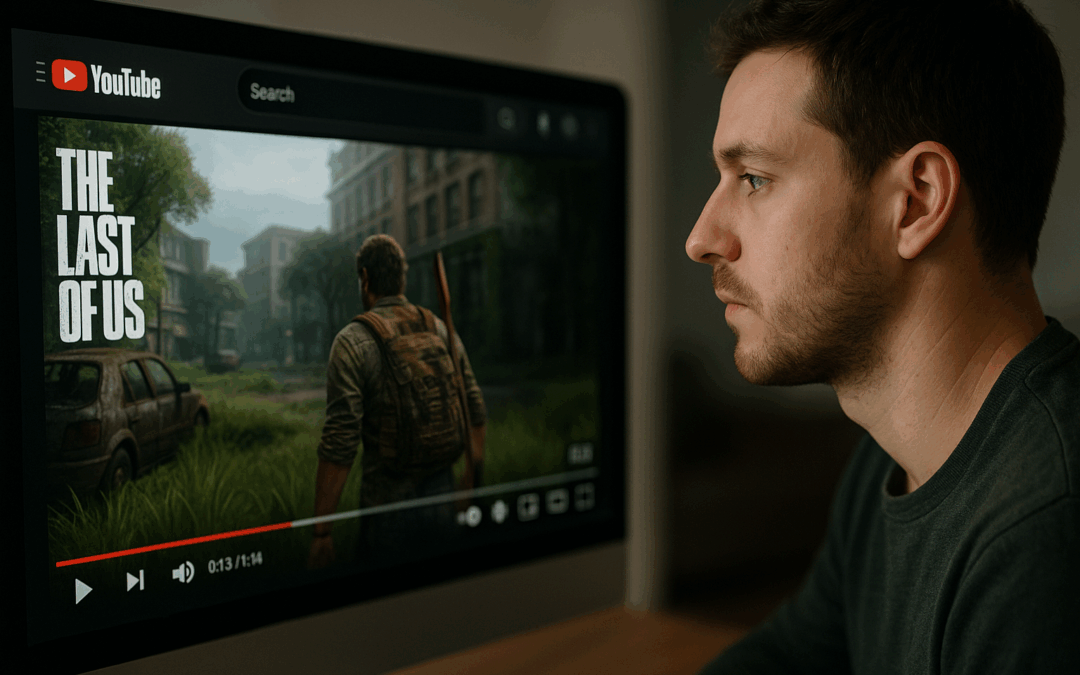
There’s a reality setting in that I think we all suspect but haven’t yet taken the time to fully digest. To put it simply, in our current incarnation as gamers, it seems less people PLAY video games than WATCH video games. Yes, this seems like a strange premise to throw out for an industry whose definition and uniqueness is all about the ‘interactivity’ that video games bring to the table.
After all, video games are designed and meant to be ‘PLAYED’. Full Stop.
“Play” is the verb here, the action. A game is created to very specifically and intentionally be ‘PLAYED’ with, upon, in conjunction, solo or to be social. So, what’s wrong with us?
Ok, maybe this isn’t something specifically ‘wrong’ but our current gaming actions are, on the surface, quite different than where the industry started with pay-for-play gaming, where you dropped a coin into a machine to buy the right to interact with whatever digital world was presented on the CRT (cathode ray tube, for the non-techies). This was the Golden Age where everything was new, each new game an innovation in some way nobody had ever seen before, and most came with rudimentary AI overlords that all needed to be vanquished.
This was our origination as an industry and movement; entertainment created specifically to be interacted with. If you couldn’t interact with it, then it might as well be a TV show or a Movie. We’re talking the difference between a linear narrative and an interactive narrative. Even the term ‘game’ generates references to something that must be played, touched, challenged, contested, etc. It’s a very tangible and visceral thing.
Video gaming started in the absence of emails, websites, the internet and most importantly social networking of any kind. Back then social networking could best be described as sneaker-net, where you’d have to walk into someone’s physical presence to have a true social interaction. Phones were transitioning from rotary dial to tone dialing and eventually becoming fully remote and losing its umbilical cord with the wall.
Today we have not just social networking and all things internet, but we also have YouTube and TikTok, as well as the advent of AI everything, for better or worse. Influencers have made careers from their bedrooms, and the younger generations thinks of YouTube and TikTok the same way the older folk used to talk about CBS, NBC and ABC. Quite the transition of media consumption in the 50+ years of video gaming.
So back to the initial premise here, if we’re not all playing the games, and video games are by far the largest form of entertainment in the world (bigger than the film and music industries combined!), then how are we using and abusing video games?
The answer lies in all the alternative ways we now consume entertainment in general and that video game brands, characters, themes and competitions have spilled over into just about every other form of media as well.
Perhaps the best way to formulate the larger conversation is to start with the simplest form of communication, the dreaded list-of-stuff. So, in thinking about the question, “How do we consume video game content today” it’s pretty easy to generate a somewhat workable list. This isn’t all-inclusive I’m sure, but enough to get the conversation started.
So, to the key question, “How do we consume video game content today?”
Based on various research activities, here’s one attempt to answer that question:
- PLAYING THEM (well, of course)
- Video Game Reviews (written, podcast or video)
- Twitch / YouTube Personality Streaming
- Online Analysis
- Video Playthroughs
- Tutorials / How-to-Play
- General Strategies (to get through a game or past a puzzle)
- eSports strategies (how do I get better)
- Esports spectators / commentators
- Articles / News
- Social Media Discussions (good, bad and other)
- In Person eSports Spectating (auditoriums, stadiums, etc.)
- Conventions (Comicon, Arcade Expo, FanX, PAX, etc.)
- Cos Play
- Collecting (figurines, loot boxes, current and retro games)
- Fan Art
- Gaming Mods
- Documentaries / Movies / Stories
- Comics / Novels
- Game Jams
- Video game music concerts
As mentioned earlier, this probably isn’t an exhaustive list, but at least a good representation of how stretchy video game content has become.
Now, we could go in depth into each specific area, but really the key thing to really take away from all this, is that only one of these items is ‘play the game.’
So, is this a PROBLEM or a logical evolution?
If you’re a developer or publisher of games, you could look at this through two diametrically opposed lenses. First is the positive side where you are excited that your game has so many ways for players to experience it, some created by you, others by the fans themselves. It’s also easy to record all of these as valuable impressions, and if you’re in the marketing world, the more impressions you get the more people you can convert to sales. So, all good on this front.
We also have the evolution of quality of content, mainly in character development and story-telling, whereas only a decade or so ago, most sins in video game writing were basically cast off as, well, ‘that’s just video game writing’ and we all accepted it. You know, back when Laura Croft could poke an eye out with her chest. Now games like “The Last of Us” 1 and 2, as well as countless RPGS are judged on their story development and character arcs first, which is a new thing for video game expectations. For recent debates on this topic, look at just about every review of Dragon Age: The Veilguard, pro and con.
A focus on story and characters in the interactive space, certainly changes many peoples views of makes for good interactivity, or the need thereof.
The other way to take this, also from the developer’s and publisher’s point of view, is that the only real way they make money on their game is by those that buy it specifically to ‘play’ it. With a few exceptions, of the 21 different ways listed above people experience video game content, only ONE of them is playing the game, and thus buying the game, which means direct revenue. Yes, in-app purchases, advertising, DLC content and the like all continue to contribute revenue to the creator of the game, but the user must still purchase or download the game first, and then, heaven forbid, actually ‘play’ the game in order to have a chance of earning revenue.
The other 20 or so items? Well, lots of other people make money on the gaming content, just not the developer or publisher. For example, Google and TikTok make money off ads from all the views, but don’t share that revenue with the game’s actual creator.
Some of the items can generate some additional revenue from licensing or perhaps esports media rights, assuming the game is successful enough, but the rest, mainly revenue for others, if there’s revenue at all.
So, again, is this a problem?
If you’re the creator, you can actually use this realization to assist with feature development and hopefully help the game get more impressions through creative inclusion of ‘streamable’ features.
Games that allow you to create (i.e. Minecraft, Mario Maker) tend to get a lot of viewership as influencers enjoy sharing what they’ve created and fans enjoying seeing what others have done. Horror game designers are actively thinking about the jump scares and similar moments that may give influencers extreme reactions, which makes for fun viewing. In the same vein, those focused on building their game into an eSports community think about spectator modes and the possibilities of top players sharing their strategies on how to be the best.
If you’re designing an action game, more effort can be put into your character designs to make them memorable in the hopes of them being brought to life through cosplay or possibly even merchandising options which might actually bring in some licensing money.
In thinking this way, you are then thinking about your audience and the community it will create around your game. Is there revenue for you with this thinking? To be honest, only if you believe in the ‘impressions’ play where you connect billions of impressions to converting people to playing the game.
Personally I don’t think they always work as the mindsets of players are changing and people that call themselves ‘gamers’ are actually playing games less and less with their available time, because they are too busy watching other people play their favorite game for them.
Case in point, did more people buy Last of Us than watched Last of Us being played through? I could throw lots of numbers at you on this to justify the argument, but to keep things simple, although Last of Us is a huge property and has a huge fan base, the number of people ‘watching’ last of us (the game, not the HBO version) is astronomical. To actually add a piece of data to the conversation, according to Google’s business insights, over 200 million people watch gaming content on YouTube daily. DAILY. Let that sink in for a moment. Oh, and that’s just YouTube.
Also, when we talk about the general size of our industry, the revenue numbers historically reported only take into account the direct revenue the games make through selling and playing, not any of those additional streams of content digestion. According to NewZoo, the Global games market for 2024 was approximately $188 billion in size which clearly isn’t too shabby.
So, is there an ‘action’ or ‘call-to-arms’ here recognizing the reality of our gaming audience is transitioning from an actual ‘playing’ audience to a more passive ‘digesting’ audience?
If I’m on the development and publishing side of this equation, then I see 20 different verticals or business models that currently don’t bring me any revenue. I would be looking to the future to strategize how we can monetize each of those streams to enhance the existing revenue we’re already getting. After all it’s no secret that game budgets are out of control and we can’t just keep spending as the current revenue from the average game doesn’t support it. Instead, we either have to reduce spending on making games, and/or, create new revenue streams that increase what can be made with a single product.
This transition that’s happening doesn’t show any signs of changing at the moment, in fact it appears to be accelerating from active to passive digestion of video game content. If you’re a gamer and have been for years, look back at the time you spend playing games and how that has changed over the years. My guess is that number of hours spent gaming has not increased, but the amount of time spent within the video game scene may have actually increased, just not devoting the same time to playing as we all used to.
AS they say, step one is to realize you have a problem. I think we’re at step one now. Once that is on the table, the calculated actions can be put in place to embrace this change and provide forward-looking actions on it.
So, where do we go from here?
I choose to embrace this new way consumers are driving the consumption of video game content and let the designs and business models also embrace it. There’s got to be a new platform or business model on the horizon that can take advantage of all this in some way, and the trick here is to be one of the first to figure it out. Like most gaming endeavors, it’s a puzzle yet to be solved.
We’re back to a blue ocean strategy here as we can see and track where people are spending their time with our precious video game content; we know where you are what you’re doing, well, in a non-creepy way. Now it’s just a matter of capitalizing on it in a unique way, very much the same way we started this industry with inventing new and innovative ways to interact with pixels on TV screens, and we called it ‘fun’.